Monday, 2 January 2017

BrightMed Session 1 and 2: Year 12 Begins!

Hi everyone,

On the 15th October and the 3rd December I had session one and two of Year 12 BrightMed! So, here are my write ups!

15th October


 Cancer

 
www.celldiagram.net


To start, did you know that 1 in 3 people get Cancer? That's 33% of all people at some point in their life, and it all starts with the mutation of one cell...

On a more positive note, 50% of people survive cancer (to live 10 years or more).

We can classify it using the "Six Hallmarks of Cancer"

  1. Autonomy from growth signals - generally we know that cells require messages to start growth. But for cancer cells, this isn't seen as they use "Autocrine signalling".
  2. Evasion of inhibitory signals - the tumour suppressor genes do not work on these cancer cells (to note, proto-oncogenes are also now activated, which help regulate cell growth)
  3. Evasion of programmed cell death (apoptosis) - Apoptosis cannot activate in cancer cells
  4. Unlimited replication - immortal cells
  5. Blood vessel formation - they receive a continuous supply of nutrients
  6. Invasion and spread - they metastasize 

 This means that multiple mutations accumulate over time. Usually this leads to cell death, but somehow they manage to survive.

Now that we've covered the basic ideas of cancer, my next task was to cover a particular treatment for cancer. Mine was Hormonal therapy, and I used breast cancer as an example.

Hormonal Therapy


Hormonal therapy is not hormone replacement. It is the giving of synthetic drugs to block the body's natural hormones. For instance, on breast cells, you can either lower the oestrogen or block the action. However, hormonal therapy is not effective against things like hormone-receptor-negative breast cancers - hence the name.

Examples for breast cancers are
  • Aromatase inhibitors - aromatase is an enzyme that synthesises oestrogen
  • Selective oestrogen receptor modulators - these are gents which bind to oestrogen receptors
  • Oestrogen receptor down regulators - these block the effects 
As an alternative, some people may choose to have their ovaries and fallopian tubes removed, or shutdown temporarily.

Some of the side effects of breast cancer hormonal therapy are:
  • Hot flashes
  • Fatigue
  • Mood swings
  • Vaginal dryness and discharge
  • Weight gain
  • Headaches
  • Depression and mood swings


 3rd December

 Introduction to Ethics


What is ethics?
 
Ethics is a branch of philosophy which involves the study of right and wrong.

An important note is that ethics involves consistence - you can't have a principal and only apply it to certain things, it must be ubiquitous!

We all have a sense of personal morality. It helps us decide between right and wrong, where we consider the pros and cons, and think about both our own, and our social moral principals.

What types of ethical theories are there?

 Consequentialist - utilitarianism
Non-Consequentialist - Deontology, contractarianism

Utilitarianism 

Jeremy Bentham transformed ethics from pleasing God to pragmatic concerns. His principle:

The act to produce optimal amount of happiness.
 Benefits:
  • Egalitarianism
  • Intuitive - makes sense to want to please everyone
  • Easy to follow
  • Flexible - Different contexts require different responses
Social Contract Theory

"Social contract theory, nearly as old as philosophy itself, is the view that persons' moral and/or political obligations are dependent upon a contract or agreement among them to form the society in which they live." - www.iep.utm.edu/soc-cont/

Thomas Hobbes - Leviathan:

 In regards to morality "... In order to live together optimally"
He said that life without social contract - a world without morality: "The life of man, solarity, poor, nasty brutish and short"

Our facts of human existence:

  1. We have quality of need
  2. Resources are scarce
  3. We have equality of facilities
  4. Altruism is limited
People must abide by social contract - this builds trust with no life of fear and self interest.

With civil disobedience, the social contact can change.

Weaknesses:
  • Hypothetical structures
  • Entirely implicit
  • We sign up because of fear: cost-benefit analysis
Another thing to consider: do we have duties towards: babies, non human animals, oppressed people, the planet and our descendants? 

Deontology
The categorical imperative - devised by Emanuel Kant

To clarify, an example of a cateogrical imperitive is "you ought not to kill" whilst a hypothetical imperative is "if you want... then...". This creates a universal law.

However, the problems with it are as followed:
  • It's wrong to lie
  • It's wrong to be complicit in the killing of innocent people
  • It's too idealistic
Health Ethics
 
Now to put this in regards of medicine, it's incredibly important for doctors to be aware and put into practice the four principles of medicine:

  1. Autonomy -  the patients' needs (decision making)
  2. Beneficence - Doing good (the Hippocratic oath)
  3. Non maleficence - Do no harm
  4. Justice - Considering treating equally 


What do you think on everything discussed today? Let us know, I'd love to hear what you think!

- Geeker

I'm Back: Let's Turn Over a New Leaf!

Wow, it's been a long time since I've posted in a while!

I've been really busy with classwork and of course all my other hobbies! One of them includes using my microscope... Recently I've been switching from looking at prepared slides, to doing a lot of at-home experiments myself. Including making a print of a leaf!

Here's one of the slides I prepared earlier:


 I love the fact that you can see the stomata and the guard cells!

Anyway, stay tuned today, as I'll be posting an update about my BrightMed!

And of course, Happy 2017!

- Geeker

Friday, 7 October 2016

First-Aid Friday: Seizures

 To finish off the weekdays quite nicely, let's take a look at the types of seizures.

In fact, how about we elaborate on each throughout the week...

  1. "Grand Mal"
  2. Absence
  3. Myoclonic
  4. Clonic


- Geeker

Wednesday, 5 October 2016

Friday, 30 September 2016

The Journey Through a Cell - Packaged and Ready to Go

 So we're back in the Golgi Apparatus, where lots of little things occur.

For us, a tiny little protein, visiting the Golgi Apparatus is an important part of our journey, where there are folds called "cisternae". Here, in the Golgi Apparatus, we are modified after entering the cis face and then packaged into little membranous sacs called vesicles, upon leaving the trans face.

[Source: http://www.buzzle.com]

These vesicles are perfect for storage and transport, and contain a single membrane with fluid inside.

Now we're all packaged comfortably into our vesicle, we'll journey again through the cytoskeleton

[Source: cellspd5spering.wikispaces.com]

We're all ready, but how do we escape the cell?

Stay tuned!

- Geeker

The Journey Through a Cell - It's Just the Beginning

Since I've been very busy with studies recently, I thought I'd show you some of my work.

So here's some A-Level Biology!

The Journey Through a Cell - It's Just the Beginning


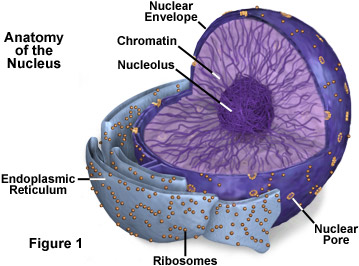
We begin in the nucleus - where all our genetic information as chromatin (containing DNA and histones) is condensed into chromosomes. Inside here we've also got the nucleolus, which is responsible for making RNA molecules and ribosome. We've got a surrounding nuclear envelope, and small nuclear pores - allowing only certain molecules to pass in and out of the nucleus. So let's say we're an RNA molecule, after being made in the nucleolus we pass through the nuclear pores...


 Our next stop is at the endoplasmic reticulum, where there are two types:

  • Smooth Endoplasmic Reticulum
  • Rough Endoplasmic Reticulum
Now, you might be asking how tiny organelles can be "rough". Well, the smooth endoplasmic reticulum (SER) is responsible for carbohydrate and lipid synthesis. However, the rough endoplasmic reticulum (RER) which is where we're heading, contains many ribosomes on its surface - making it rough.  These ribosomes are the main site for protein synthesis, so it turns our small RNA body into a protein.


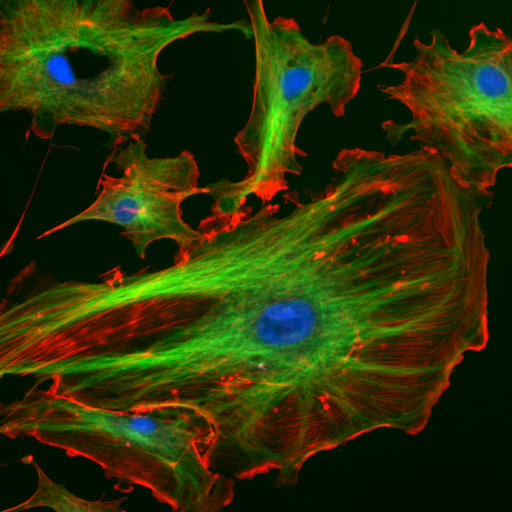
After venturing through the SER, we hop into the tracks of the "Cytoskeleton" which is responsible for many different things. It's made up of three components:

  • Microfilaments  - Contractile actin fibres which are responsible for cell contraction and cytokinesis
  • Intermediate fibres - for strength and integrity of the cell
  • Microtubules - (which is where we're heading) for not only a component in spindle fibres, but also "tracks" for transport of molecules within a cell. 
"Actin filaments are shown in red, and microtubules composed of beta tubulin are in green."

Now we travel down to the "golgi apparatus"

What happens next? Stay tuned for more!


- Geeker

Sunday, 28 August 2016

Update and the News!

Hi Everyone,

Thought I'd make a quick update post on what's been happening recently! So, I just received my exam results, which I'm extremely happy about! Been doing some studying of this and that.

For now, have you read the article about the NHS's cuts?

"The BBC has seen draft sustainability and transformation plans (STPs) which propose ward closures, cuts in bed numbers and changes to A&E and GP care in 44 areas."

Read more here: http://www.bbc.co.uk/news/health-37186455


- Geeker

Sunday, 31 July 2016

Work Experience Was Absolutely Amazing!

So I've been very busy recently; more specifically, with Work Experience!

It was absolutely amazing!

On Monday I got to observe some Neurology consultations, where the speciality is in dizziness, headaches, Parkinson's, MS, epilepsy, etc.


Then, for the afternoon I stayed with a doctor who works in dermatology. So we were reviewing skin complaints associated with skin cancer.


On Tuesday I was based in Rheumatology where I saw rheumatoid arthritis, osteoarthritis, rotator cuff tears, Sjögren's syndrome, and polymyalgia rheumatica.


For the afternoon I was then based in the Day Care unit, where I witnessed endoscopies and colonoscopies. 


On Wednesday I was in the MS Clinic, but also saw a case of neuromyelitis optica and cases of strokes.


For the late afternoon, I was then based in endocrinology for the last half hour.


On Thursday I was in the Acute Medicine unit on Wards 1 and 2. This was where I witnessed cases of pneumonia, chest infections, bed sores, generalised stomach problems, etc.


For the afternoon, I went back to the day care unit to watch some OGDs, flexible sigmoidoscopies and other scopes.


On Friday (my last day, sadly), I was in Radiology. I was scrubbed up to watch an angiogram (cardiac catheter) and a pacemaker being changed in the Cath Lab. Then I watched an ultrasound, fluoroscopy and liver drainage.


 Finally, I went back to the Day Care unit to watch a bronchoscopy!


Overall, my experience was completely amazing. Aside from the fact that I was able to witness some absolutely incredible procedures, the actual patient care and communication was incredible. I was able to reflect on the effectiveness of teamwork, especially in MDTs, and the daily activities that doctor's carry out. Of course, I had a lot of contact with the nurses too, and it was nice to see how they work together. I've learnt to open my mind to the countless possibilities that medicine can offer, consider the key qualities that make a good doctor, to always listen, and to always be true to myself by striving for what I care about most.


- Geeker

Tuesday, 12 July 2016

Last Week's Answers 18!

 Secret Sunday

Brain nervous limbic system

Mash-Up Monday


 - K I A Z = Zika
- P A T E N C H E L I S I = Encephalitis
-  N A D G U A = Uganda
-  S I T M O O Q U = Mosquito
- R I V U S = Virus


- Geeker


- Geeker

Monday, 4 July 2016

Secret Sunday and First-Aid Friday

I thought I'd cover both Secret Sunday and First-Aid Friday in one post!

Here are some symptoms that the NHS has provided:

  • tiredness and weakness
  • feeling faint or dizzy
  • a decrease in blood pressure
  • a headache
  • muscle cramps
  • feeling and being sick
  • heavy sweating
  • intense thirst
  • a fast pulse
  • urinating less often and having much darker urine than usual 
 Any idea what this could be?


- Geeker